Plug-ins for Logic Pro
Tools for the mix.
Plug-ins from Paragon Design for Logic Pro and other hosts. Essentials such as an equaliser and a compressor, and specialist tools for level matching, make-room carving, release checks, phase alignment, transient shaping and a whole vocal channel. Birch on the outside, careful measurement on the inside.
- Audio Unit & VST3
- Three are free
Essentials
The ones you reach for in every session.
The processors every session needs, each one standing alone and each one with a display that shows what it is doing.
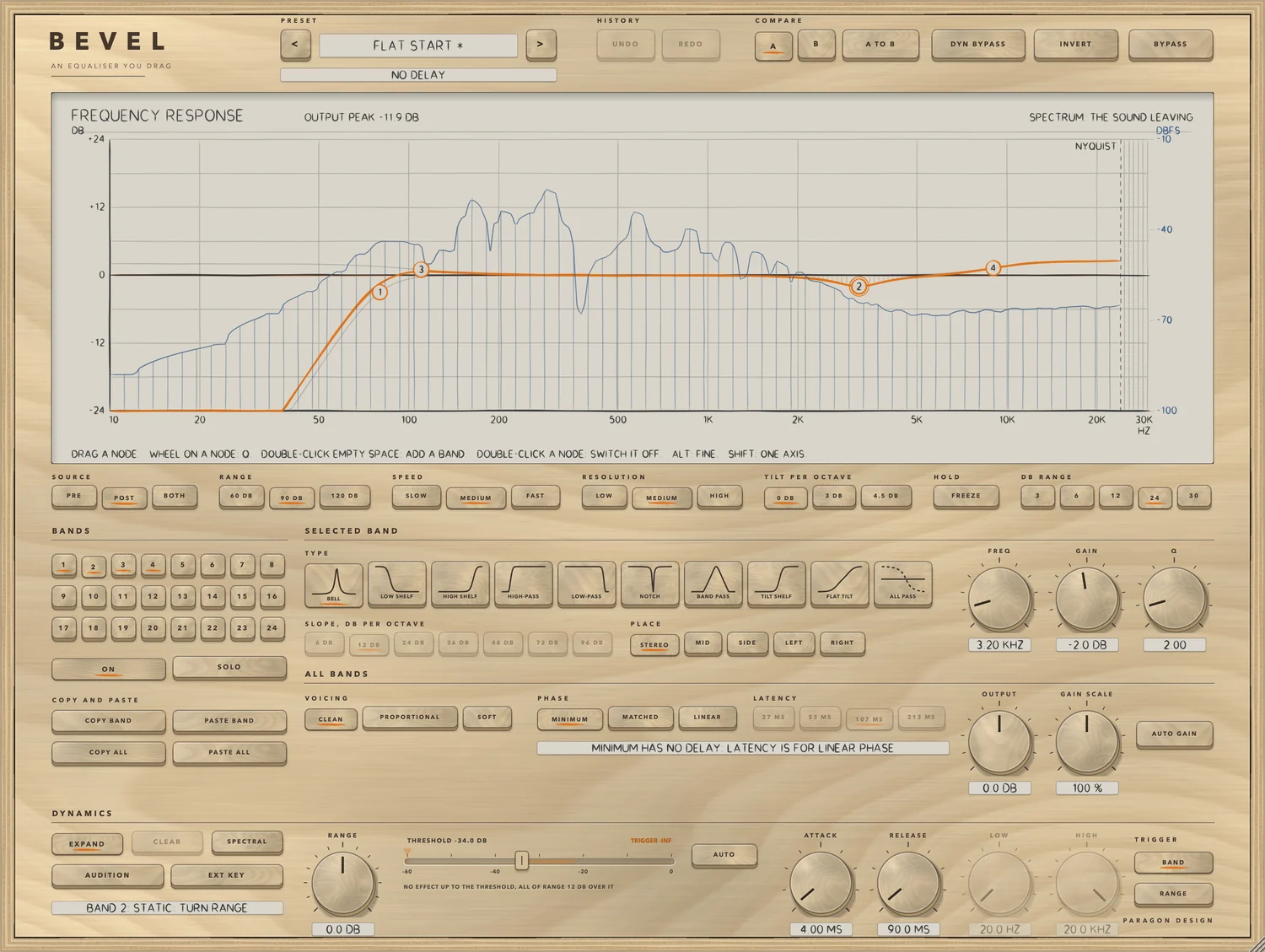
Double-click the display to add a band, then drag its node: frequency across, gain up and down, the wheel for Q. Up to 24 bands in ten shapes, each on the whole signal, on its middle or its sides, or on the left or the right channel, with the spectrum of the sound moving underneath. Any band can be dynamic: its gain follows the level in its own region, in a range of frequencies you choose, in a side chain or, with SPECTRAL, in each frequency on its own. The curve on the display is the curve the filters run.
- The display is the control
- Twenty-four bands, ten shapes
- Five places
Specialist tools
The ones that solve one problem properly.
Matching levels for a fair listen, checking a release against a reference, carving room for a voice, setting up a whole vocal: jobs the essentials do not do.
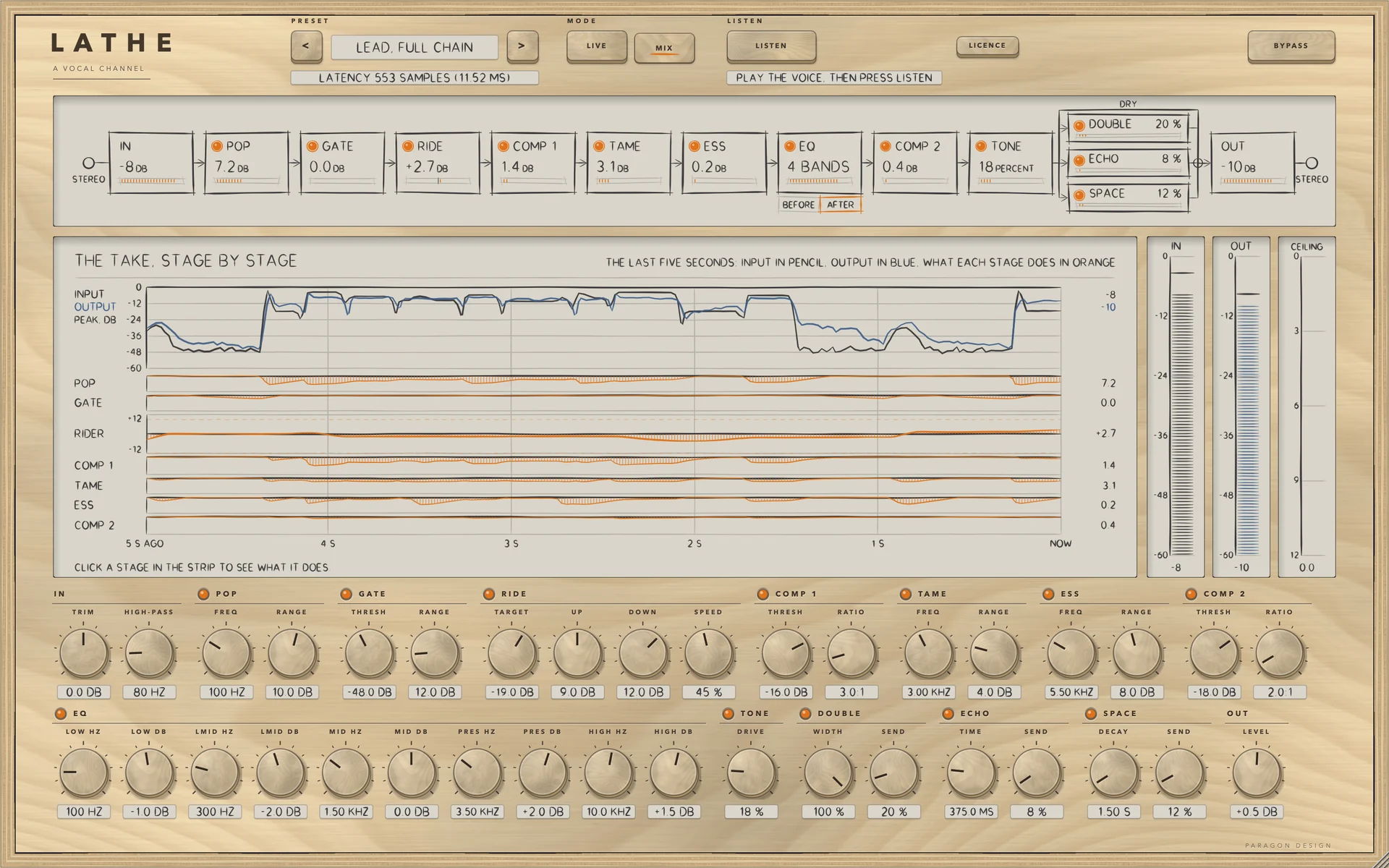
One strip for a vocal, in a fixed order: input trim and high-pass, a plosive cutter, a gate, a rider that holds the level, a compressor, harshness and sibilance cutters, an equaliser, a second compressor and saturation, then a doubler, a delay and a reverb on sends, and an output stage with an optional ceiling. One display shows the take stage by stage, and LISTEN measures a take and sets starting values you can see and undo.
- One strip, in vocal order
- A rider that holds the level
- Three cutters that act only while they must
Measured, not claimed
Every figure is from a test.
A claim on this page has a number behind it, and the number came from the plug-in’s own tests, run on the built plug-in. Where something has not been checked, we say so.
- 0.435 dBHow far a +12 dB bell at 20 kHz with Q 1 departs from the analogue prototype's curve at its worst point at 44.1 kHz in MATCHED (limit 0.5 dB), against 8.159 dB in MINIMUM. At 48, 96 and 192 kHz: 0.445, 0.484 and 0.239 dB in MATCHED, 6.226, 3.295 and 0.951 dB in MINIMUM.BEVEL
- 0.012 dBHow far a quiet tone, 20 dB under the threshold in the same band as a loud one, moved while a SPECTRAL band turned the loud one down (limit 0.02 dB); the loud tone moved by the curve within 0.5 dB, the limit. A time-domain band would have moved both.BEVEL
- Bit for bitAt rest, and in bypass, the output is the input delayed by the reported latency, in every voicing and with every look-ahead.CLAMP
- 240 samplesHow far ahead of a burst reaching the output the reduction has begun with 5 ms look-ahead at 48 kHz: the first 2 ms leave 16.6 dB under the input, against 3.8 dB with no look-ahead.CLAMP
- 111.4 dBThe least any non-DELTA setting of 57 came out below the output when the new engine was compared with version 1's on the same signals (up to 125.1 dB; the bound is 100 dB). The DELTA settings came out 94.3 to 102.3 dB below the DELTA output, and version 1's DELTA left a rounding trace 138.5 to 139.6 dB under the programme at DEPTH 0, where the new one is silent.PLANE
- Bit for bitAt DEPTH 0 the output is the input delayed by the reported latency, in each of 48 combinations of settings. Version 1 was 138.0 to 139.5 dB under it. Going from DEPTH 12 to 0, the output was exactly the delayed input after 0.39, 0.41 and 0.44 s in FAST, NORMAL and FINE at RELEASE 120 ms.PLANE
- 0 of 240Runs in which the copy of LATHE's gate differed from the original in output, trace, meter or history: GATE and EXPAND, every look-ahead, LISTEN on and off, nine sets of settings, four sample rates, noise, bursts and the voice, with the settings moved three times during a run.LATCH
- Bit for bitWith RANGE 0 the output is the input delayed by the look-ahead in 240 runs: mono and stereo, GATE and EXPAND, five look-aheads, six sample rates, every other control at its default or its hardest. A denormal input number comes out as itself or 0.LATCH
- 0 of 432Runs in which the copy of LATHE's de-esser module differed from the original: WIDE on and off, FREQUENCY 3 to 12 kHz, Q 0.5 to 8, RANGE 0 to 18 dB, THRESHOLD absolute and relative, ATTACK, RELEASE, LISTEN on and off, four sample rates, noise, sibilant bursts and the voice, with the setting moved three times in a run.SCRAPER
- Bit for bitWith RANGE 0 the output is the input, with WIDE on or off and a delay of 0, in the engine's 144 runs and in the processor at six sample rates in both layouts. A denormal input number comes out as itself or 0.SCRAPER
- 0, 25 or 29The delay in samples the processor told the host for OVERSAMPLING OFF, 2X and 4X, at 44.1, 48, 88.2, 96, 176.4 and 192 kHz: the same number at every rate. An impulse at rest came out exactly that late.CHAR
- Bit for bitWith DRIVE 0, TILT 0 and OUTPUT 0 dB the output is the input delayed by the reported delay in 54 runs and at six sample rates, in both layouts. A denormal input number comes out as itself or 0.CHAR
- 0 samplesThe delay the processor told the host at every setting tried, at 44.1, 48, 88.2, 96, 176.4 and 192 kHz, and read back from the Audio Unit at 48 kHz. BYPASS does not change it.TAP
- Bit for bitAt MIX 0 and OUTPUT 0 dB the output is the input in 36 runs and at six sample rates in three layouts, with FEEDBACK 110, FREEZE, DUCK, DRIVE, DIFFUSION, MOD DEPTH, WIDTH 200 and R TO L set. Through the installed Audio Unit 18 of 18 runs were equal. A denormal input number comes out as 0 and a minus zero as plus zero.TAP
- 0 samplesThe delay the processor told the host at every setting tried, at 44.1, 48, 88.2, 96, 176.4 and 192 kHz. BYPASS does not change it.CASK
- Bit for bitAt MIX 0 and OUTPUT 0 dB the output is the input in 36 runs (six modes, three layouts, with FREEZE, GATE, DUCK and DECAY 30 s on and off) and at six sample rates. A denormal input number comes out as 0 and a minus zero as plus zero.CASK
- 241 samplesThe delay told to the host at the defaults at 48 kHz (229, 241, 362, 385, 626 and 673 at 44.1, 48, 88.2, 96, 176.4 and 192 kHz): the told delay, the sum of the modules' own delays and the place of an impulse are one number in 72 structures and rates. The most is 1589 samples at 48 kHz and the least 14, found by trying all 10,080 combinations of the controls that change it.CHEST
- Bit for bitAt rest, with all eight off, the default order and both levels at 0 dB, the output is the input delayed by the told delay at every block size from 1 to 4096 samples, at six sample rates and in three layouts. Each module alone equals its engine, bit for bit, in 8 modules, two settings and two orders, and all eight on in six orders equal the engines chained by hand.CHEST
- 11.82 dBHow far the band ESS reads fell, input to output, for a sibilant burst 10 dB over the voice (median of 10 bursts); 3.36 dB of it by ESS itself (limit: at least 3 dB). The vowel beside it moved 0.023 dB with ESS alone (limit 0.3 dB).LATHE
- 11.94 dBHow far the band under 200 Hz fell, input to output, for a plosive 15 dB over the voice (median of 6); 3.12 dB of it by POP itself (limit: at least 3 dB).LATHE
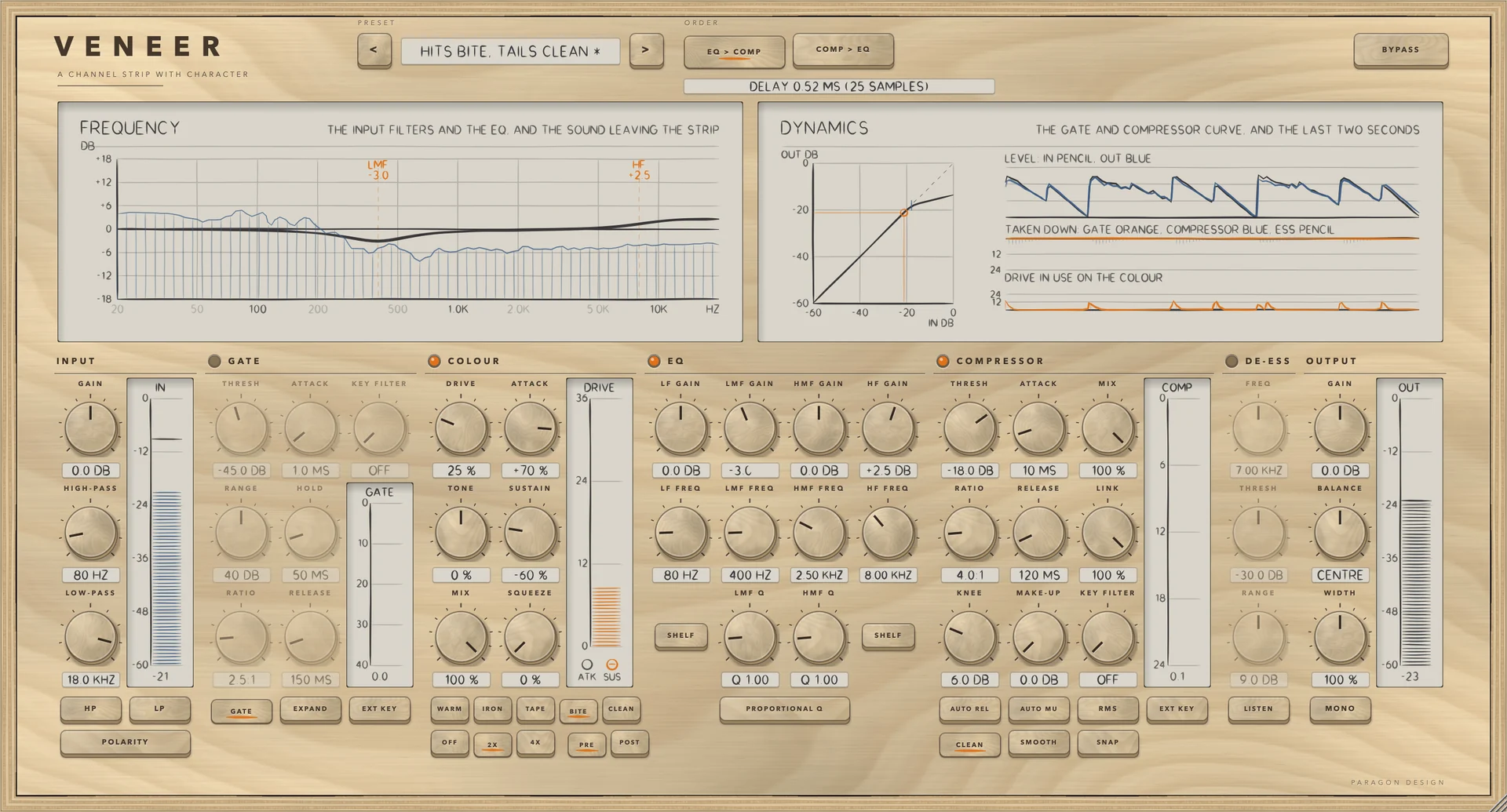
- -79 dBAlias of a hard-driven 9.5 kHz tone at 10 kHz with 2x oversampling, against -43 dB with it off.VENEER
- 25, 29Samples of delay at 2x and 4x, exact at every sample rate; the strip at rest is that delay and nothing else.VENEER
- Under -50 dBA steady tone changes by less than this with ATTACK and SUSTAIN both at +100. That is the limit the test sets; the change was inside it. Steady sound is left alone.CHISEL
- 0.33 %Worst pitch error following a voice that glides from 150 to 250 Hz.WEDGE
- -139 dBReconstruction error when nothing is carved: the track comes back as it went in.WEDGE
- 0.04 sampleThe same for HOLD, which needs no reference playing: 0.04 at 50 ppm, 0.02 at 20 ppm.SQUARE
- 0.03 LUThe reference, heard section by section, comes within 0.03 LU of the mix's loudness.GAUGE
- Exactp-values are the exact binomial: 10 of 10 is 0.0010 and 12 of 16 is 0.0384 (the panel rounds to three decimals).LEVEL
Measured on synthetic signals by each plug-in’s own tests, against the shipped build. They are measurements, not listening tests: they say what the code does to a test signal, and nothing about how it sounds on your session.
Made like a hand tool
Turn it. It draws the curve.
Every control is a turned wooden knob, and every display is drawn in pencil by the plug-in itself, twelve times a second, so the line never sits perfectly still.
Drag a knob up or down, or focus it and use the arrow keys. Double-click puts it back. The curve is a peaking filter from the usual audio-EQ cookbook formulas, worked out in your browser.
Gain
Freq
What they cost
Three free. Fourteen premium.
Free, with nothing held back
Start here.
BEVEL
An equaliser you drag.
CLAMP
A compressor with six voicings.
PLANE
A resonance reducer.
Each is the whole plug-in. Free here means free: no trial, no nag, no account.
Specialist tools, premium
The ones that do the heavy lifting.
LATHE
A vocal channel strip, in vocal order.
VENEER
A channel strip with character.
CHISEL
Shape the attack and the sustain apart. No crossover.
WEDGE
Make room for the voice.
SQUARE
Line up a track with a reference: time, polarity and phase.
GAUGE
Check a release. Match a reference, section by section.
LEVEL
Blind ABX and ranking, with every source matched in loudness.
The Workshop
VENEER, CHISEL, WEDGE, SQUARE, GAUGE and LEVEL together.
Essentials, premium
The tools for every session.
LATCH
A gate and expander.
SCRAPER
A de-esser with one band.
CHAR
A saturator with three curves.
TAP
A delay with three characters.
CASK
A reverb with six modes.
RIDGE
A look-ahead limiter with seven styles.
CHEST
A rack of eight processors.
Launch prices in USD. The premium plug-ins are available from next week, and each will work for 14 days before it needs a licence. Write to be told the day they are out.
Owner’s manuals
A manual for every one.
Each manual covers every control, every display and every number on this page, with the pictures numbered to match.
Essentials
Built at the bench.
The free installers are signed, notarised and ready. The premium plug-ins are available from next week. Pick a free one, or read any manual first.
17 plug-ins