Paragon WorkshopThe free ones

LATCH

A gate and expander.

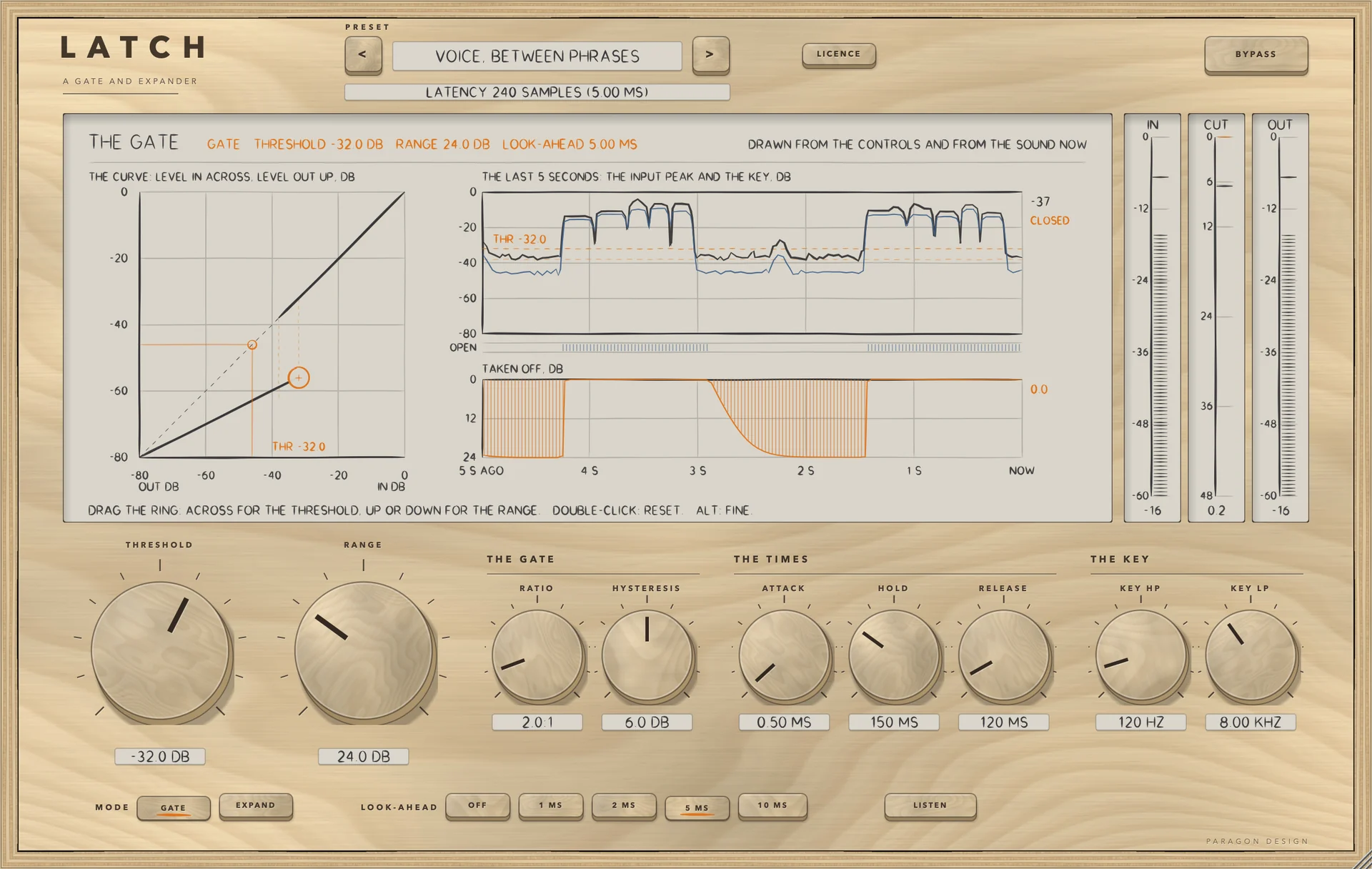
A gate and expander that listens to its own input through two filters, so a hum or a hiss does not hold it open. In GATE mode it opens at the threshold and closes once the level has fallen HYSTERESIS under it, so it does not chatter; in EXPAND mode it turns the signal down gradually, by a ratio, from the threshold. A look-ahead of up to 10 ms lets the gate be open before a sound reaches the output. The display draws the curve at these settings, the last five seconds of the input and the key, and the gain taken off, and LISTEN lets you hear what the gate listens to.

$29Available from next weekTell me when
Formats
Audio Unit, VST3
Channels
Mono in and mono out, or stereo in and stereo out; any other layout is refused
Latency
0 samples with LOOK-AHEAD OFF; 1, 2, 5 or 10 ms is 48, 96, 240 or 480 samples at 48 kHz (44, 88, 221 and 441 at 44.1 kHz), told to the host
LATCH at work

What it does

LATCH in six parts.

  1. 01

    Gate or expander

    GATE opens at THRESHOLD and closes HYSTERESIS dB under it once HOLD has run out, and while it is closed the gain is minus RANGE dB. EXPAND takes RATIO minus 1 dB more off for every dB the key reads under the threshold, down to RANGE, and holds its gain from falling for HOLD. RANGE goes to 80 dB and RATIO from 1.2 to 10 to 1.

  2. 02

    A key you can shape and hear

    KEY HP and KEY LP are second-order filters, 12 dB per octave, on what the gate listens to; the audio is not filtered. The two channels are linked by the mean of their power, so one gain is applied to both. LISTEN replaces the output with the key after its two filters, over a 5 ms crossfade, and it is off whenever a session loads.

  3. 03

    Look-ahead

    LOOK-AHEAD delays the audio by 1, 2, 5 or 10 ms while the detector reads the signal before the delay, which is 240 samples at 5 ms and 48 kHz, told to the host. A tone just over the threshold is read late, 10.8 ms at 0.5 dB over and 3.3 ms at 3 dB over, and a look-ahead hides up to 10 ms of it. Changing it while sound plays is made under a dip of 3 ms.

  4. 04

    Times you can read

    ATTACK and RELEASE are each the time to cover 63 percent of the way: ATTACK 1, 5 and 20 ms measured 1.000, 5.000 and 19.979 ms, and RELEASE 5, 20 and 80 ms measured 4.979, 19.979 and 79.979 ms at 48 kHz. HOLD, from 0 to 500 ms, closes the decision after the time set to within 2 samples in GATE.

  5. 05

    A display of the gate

    The curve with a ring that sets THRESHOLD across and RANGE up or down; the last five seconds (512 slots of 10 ms) of the input peak and the key against the threshold and the closing level, with a strip for the decision; and the gain taken off. Three meters stand beside it: IN, CUT and OUT.

  6. 06

    Nothing until you ask

    RANGE starts at 0 dB, so at Flat Start nothing is taken off: the output is the input delayed by the look-ahead, bit for bit, in GATE and in EXPAND, with each look-ahead, in both layouts and at six sample rates (240 runs). BYPASS crossfades to the input over 5 ms and the gate goes on working inside it.

LATCH · The point of it

It shows the gate working, and it listens to the key you shape.

The display is three pictures drawn from the engine's own functions and from the sound now: the curve, level in across and level out up, with a ring; the last five seconds of the input peak and the key with the threshold and the closing level dashed and a strip for the decision; and the lane of gain taken off, deeper in steps up to 80 dB. One ring is the handle for THRESHOLD and RANGE together.

Every one of the 18 presets is written as what it changes from the defaults and is held to three or four measurements, 68 in all: the level in the gaps brought down, the most taken off the sound itself in any 10 ms, how soon after a sound reaches the output the gain is within 1 dB of 0 dB, how long a sound rings and how many times the gate opens. The installed Audio Unit and the engine differed in 0 samples in each of 7 presets, on both sides.

  • 0 of 240Runs in which the copy of LATHE's gate differed from the original in output, trace, meter or history: GATE and EXPAND, every look-ahead, LISTEN on and off, nine sets of settings, four sample rates, noise, bursts and the voice, with the settings moved three times during a run.
  • Bit for bitWith RANGE 0 the output is the input delayed by the look-ahead in 240 runs: mono and stereo, GATE and EXPAND, five look-aheads, six sample rates, every other control at its default or its hardest. A denormal input number comes out as itself or 0.
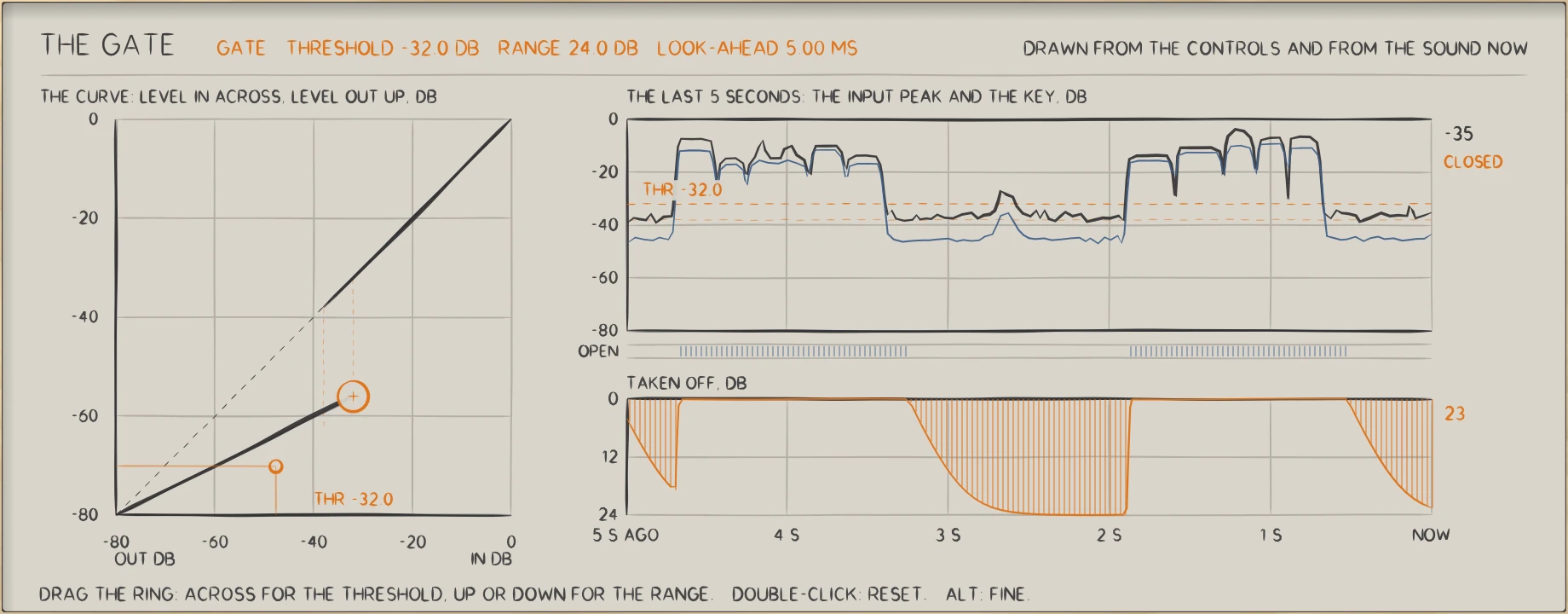
LATCH: LATCH with a voice preset at work: the curve, the last five seconds and the gain taken off.
LATCH with a voice preset at work: the curve, the last five seconds and the gain taken off.

In use

The real window, as it looks at work.

These are captures of the built plug-in, drawn by the plug-in itself at twice the size.

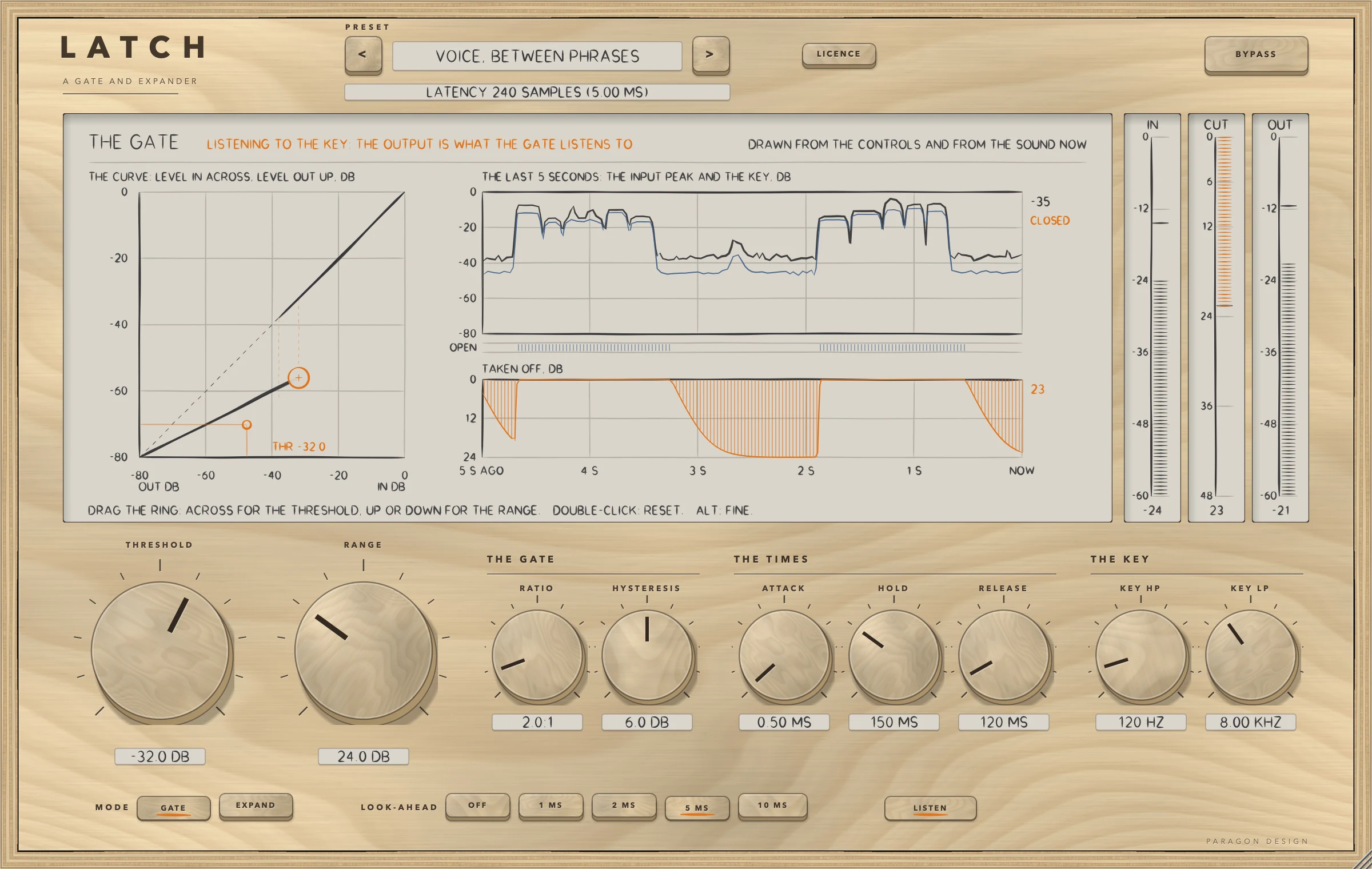
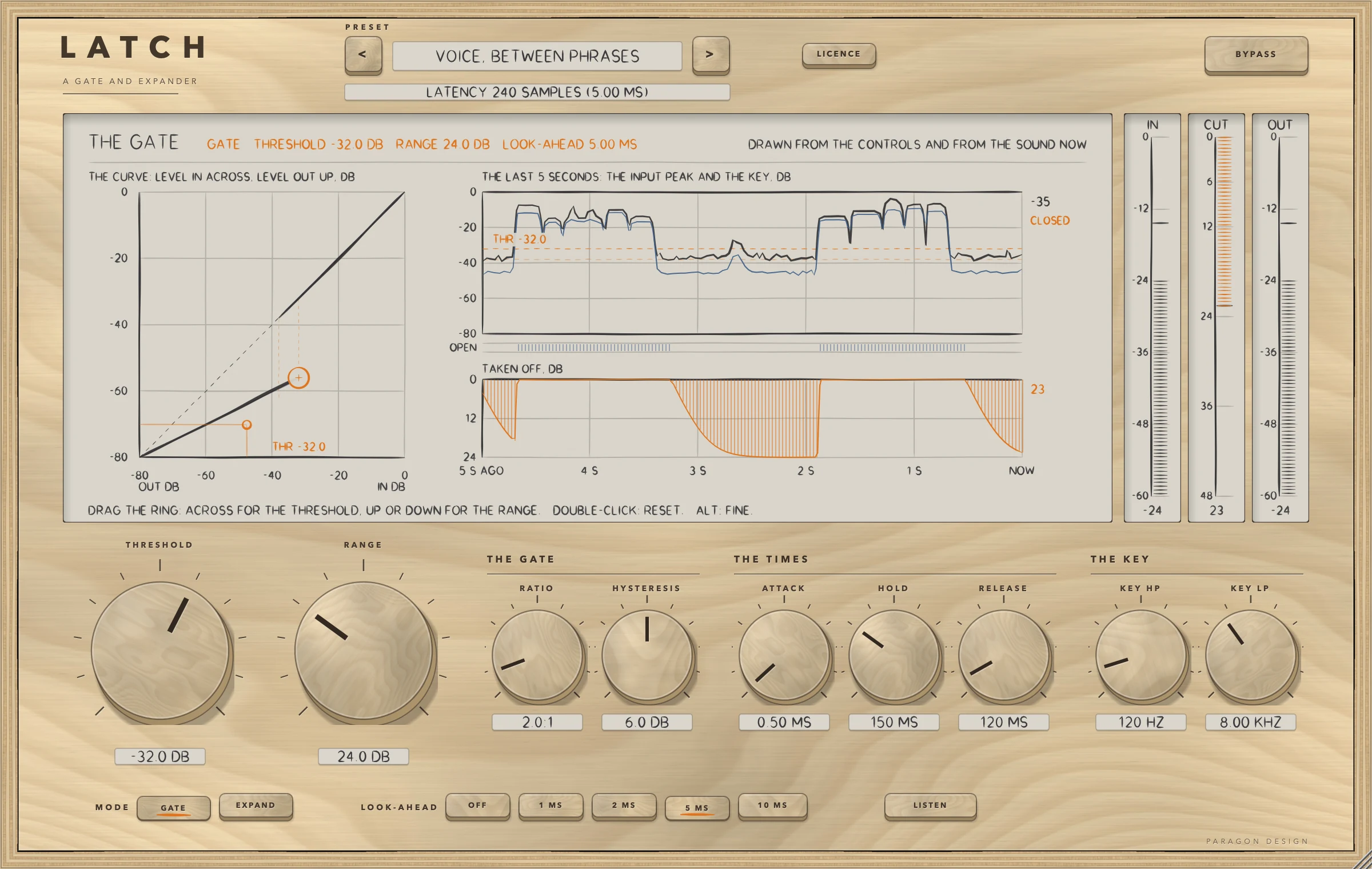
LATCH: Voice, Between Phrases with the voice playing: the curve, the last five seconds, the gain taken off and the meters
Voice, Between Phrases with the voice playing: the curve, the last five seconds, the gain taken off and the meters
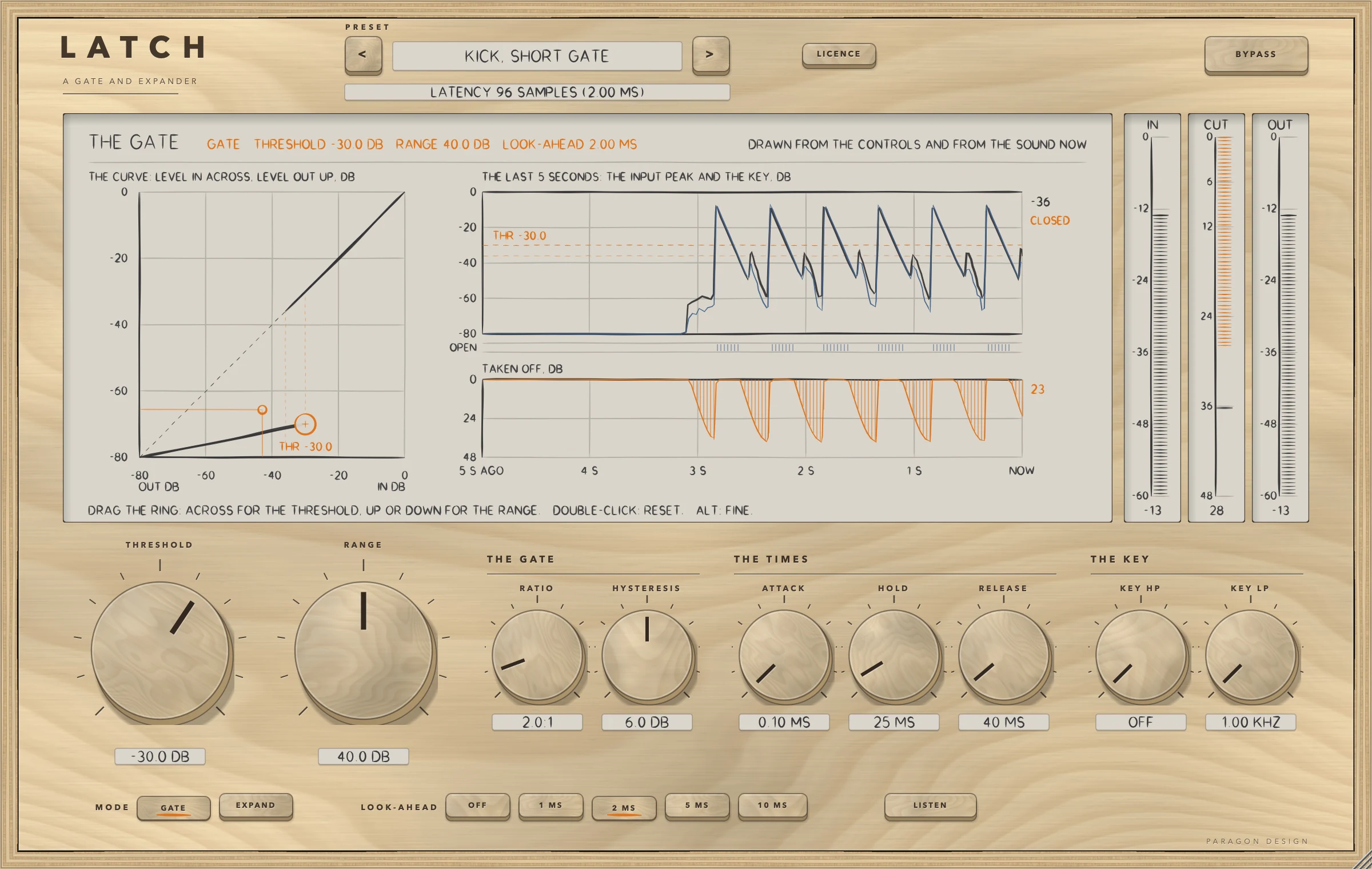
LATCH: Kick, Short Gate on a train of kicks: a GATE with 40 dB of RANGE and a look-ahead of 2 ms
Kick, Short Gate on a train of kicks: a GATE with 40 dB of RANGE and a look-ahead of 2 ms
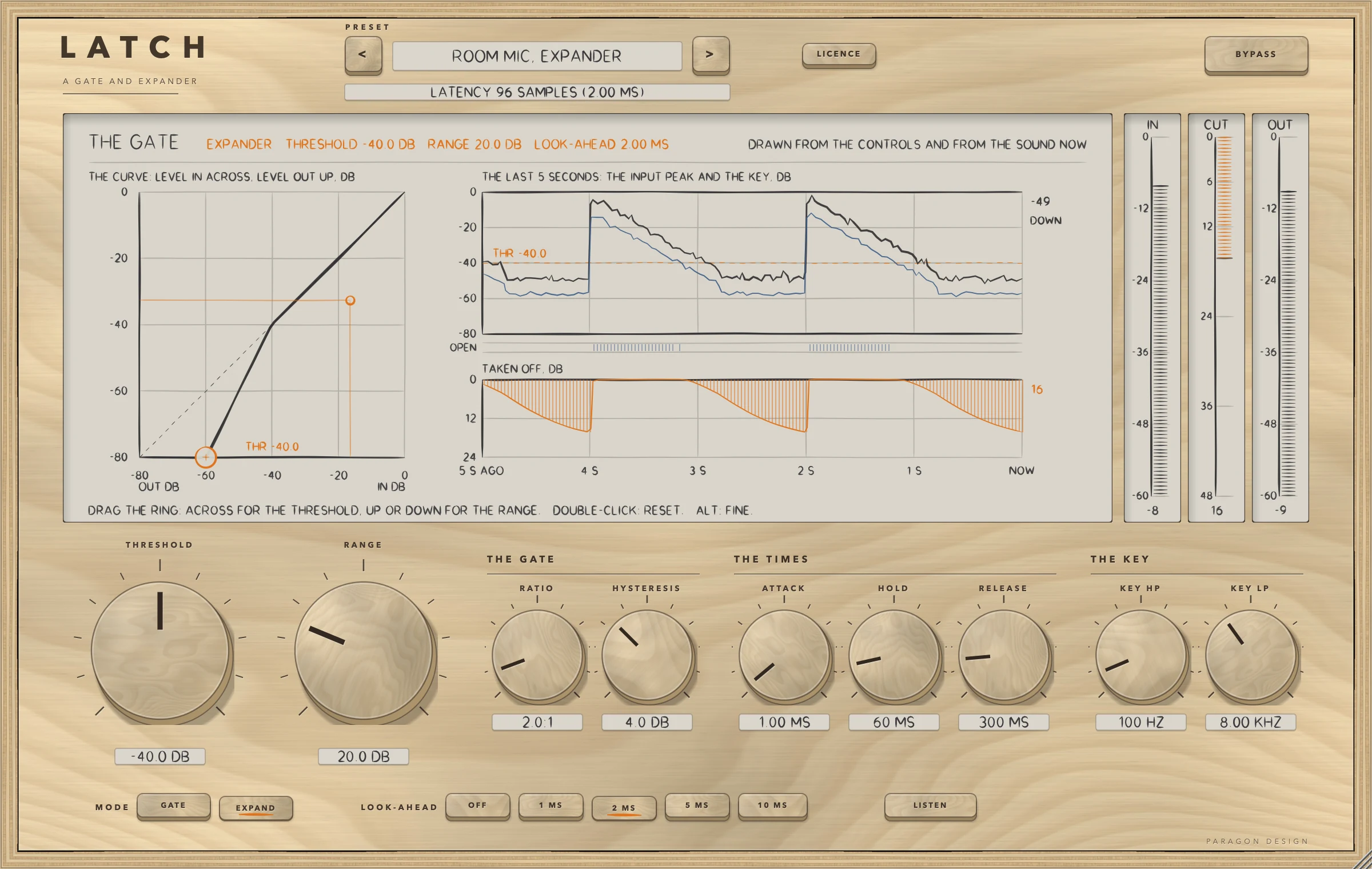
LATCH: Room Mic, Expander on falling bursts: the expander's curve, with the ring at its foot
Room Mic, Expander on falling bursts: the expander's curve, with the ring at its foot
LATCH: LISTEN on: the output is the key after its two filters
LISTEN on: the output is the key after its two filters
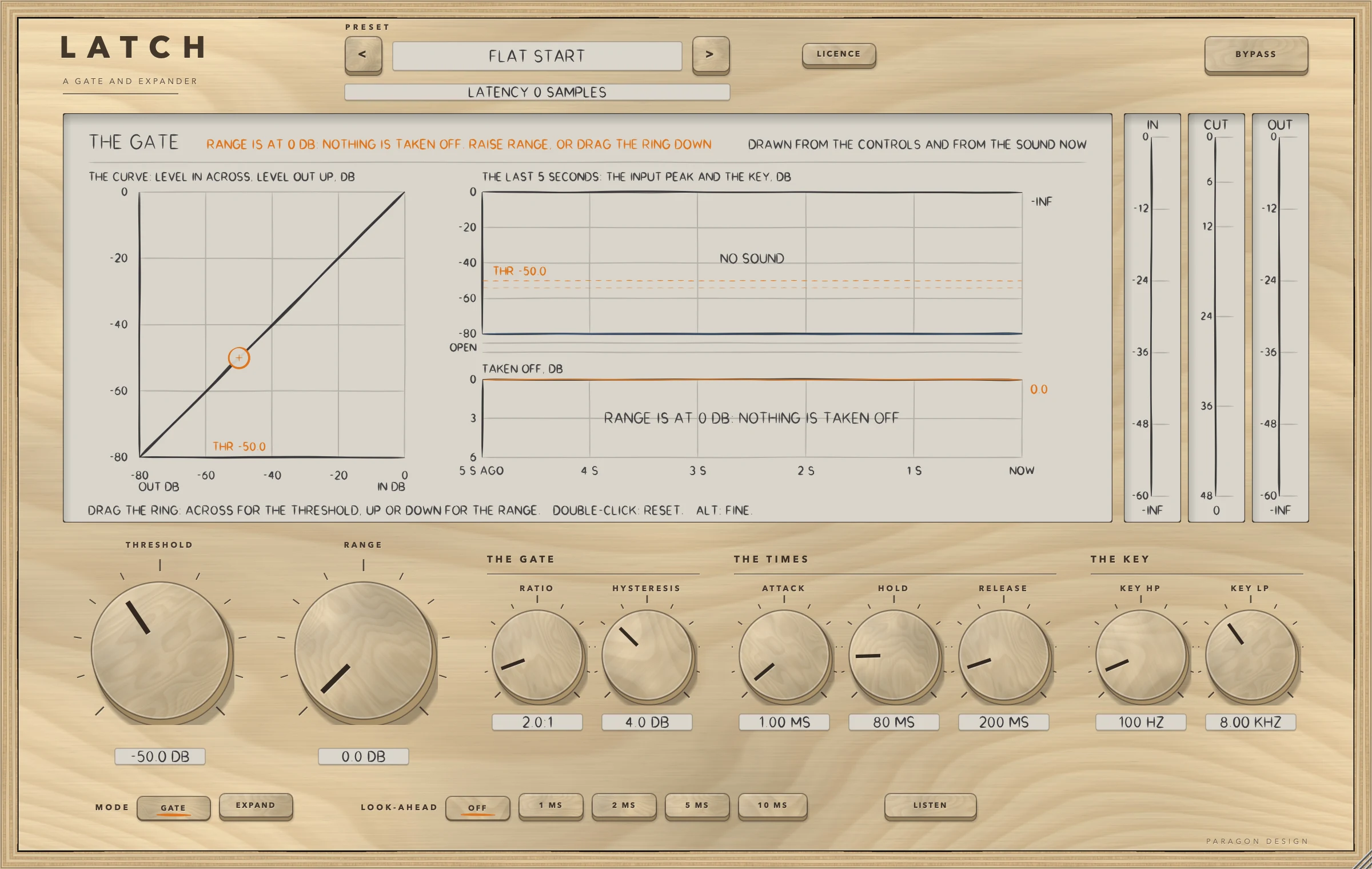
LATCH: Flat Start with no sound: RANGE is at 0 dB and the output is the input
Flat Start with no sound: RANGE is at 0 dB and the output is the input

Specifications

Formats
Audio Unit, VST3
Listed in your host as
Latch Gate and Expander
Channels
Mono in and mono out, or stereo in and stereo out; any other layout is refused
Sidechain
None: the gate listens to its own input through the two key filters
Latency
0 samples with LOOK-AHEAD OFF; 1, 2, 5 or 10 ms is 48, 96, 240 or 480 samples at 48 kHz (44, 88, 221 and 441 at 44.1 kHz), told to the host
Tail told to the host
None
Modes
GATE and EXPAND
Editor
1200 x 760 pixels at 100 percent, resizable from 70 to 170 percent
Parameters
13
Presets
18 in 6 categories
CPU
Flat Start 0.14 percent of one core, EXPAND on noise under the threshold 0.19 and the heaviest setting 0.18 (stereo, 48 kHz, 512-sample blocks, thread CPU time; Intel Core i9, a shared machine at a load average of 5 to 8, and earlier runs at 8 to 12 read 0.17 to 0.28). The budget of 2.0 percent holds in every run

Measured

  1. 0 of 240Runs in which the copy of LATHE's gate differed from the original in output, trace, meter or history: GATE and EXPAND, every look-ahead, LISTEN on and off, nine sets of settings, four sample rates, noise, bursts and the voice, with the settings moved three times during a run.
  2. Bit for bitWith RANGE 0 the output is the input delayed by the look-ahead in 240 runs: mono and stereo, GATE and EXPAND, five look-aheads, six sample rates, every other control at its default or its hardest. A denormal input number comes out as itself or 0.
  3. 1.000 msWhat a 1 ms ATTACK measured (5 ms measured 5.000 and 20 ms 19.979), and RELEASE 5, 20 and 80 ms measured 4.979, 19.979 and 79.979, each the time to cover 63 percent of the way at 48 kHz.
  4. 68 measurementsThree or four for each of the 18 presets, all inside their bounds on named programmes: the level in the gaps, the most taken off the sound itself, how soon the gate is up, how long a sound rings, the lowest gain, how many times the gate opens and the delay.
  5. 0 samplesThe difference between the installed Audio Unit and the engine in each of 7 presets, 8 s each, on both sides. The test exists because Apple's compiler once made another plug-in's installed build play only part of its sound while every other test passed.

On synthetic test signals, by this plug-in’s own tests. Not a listening test.

Presets

18 presets, named for the job.

Starting points chosen from measurements, not tuned by ear. Each one sets every control, so the result does not depend on what was dialled in before it.

Start

  • Flat Start

Voice

  • Voice, Between Phrases
  • Voice, Fast Words
  • Voice, Deep Cut
  • Voice, Gentle Expander

Drums

  • Kick, Short Gate
  • Kick, Longer Ring
  • Snare, Bleed Out
  • Snare, Soft Expander

Guitar and Bass

  • Guitar, Hum Gate
  • Guitar, Long Sustain
  • Bass, Low Gate

Noise

  • Noise, Floor Down
  • Room Mic, Expander
  • Noise, Hard Gate on Bursts

Special

  • Special, Wide Hysteresis
  • Special, Soft Attack Hidden
  • Special, Tail Trim

The first minutes

From empty to useful.

  1. 1

    Choose a preset

    Pick Voice, Between Phrases. It sets a gate with THRESHOLD -32 dB, RANGE 24 dB and a look-ahead of 5 ms. Flat Start puts everything back.

  2. 2

    Drag the ring

    Drag the ring on the curve: across for THRESHOLD, up or down for RANGE. A double-click resets it, and ALT held while dragging gives fine steps.

  3. 3

    Listen to the key

    Press LISTEN to hear what the gate listens to, the key after its two filters, and raise KEY HP until a hum or a rumble no longer shows in it.