Paragon WorkshopThe free ones

LEVEL

Blind ABX and ranking, with every source matched in loudness.

A louder version is easy to prefer for that reason alone. LEVEL takes level out of the comparison. Put up to four sources in its slots, the live input or files, and it matches their loudness before you hear a note. Then test yourself: a blind ABX with an exact p-value, or a blind ranking, with the chart hidden so nothing gives it away.

$29Available from next weekTell me when
Formats
Audio Unit, VST3
Channels
Mono or stereo, same in and out
Latency
None
LEVEL at work

What it does

LEVEL in four parts.

  1. 01

    Four slots, one level

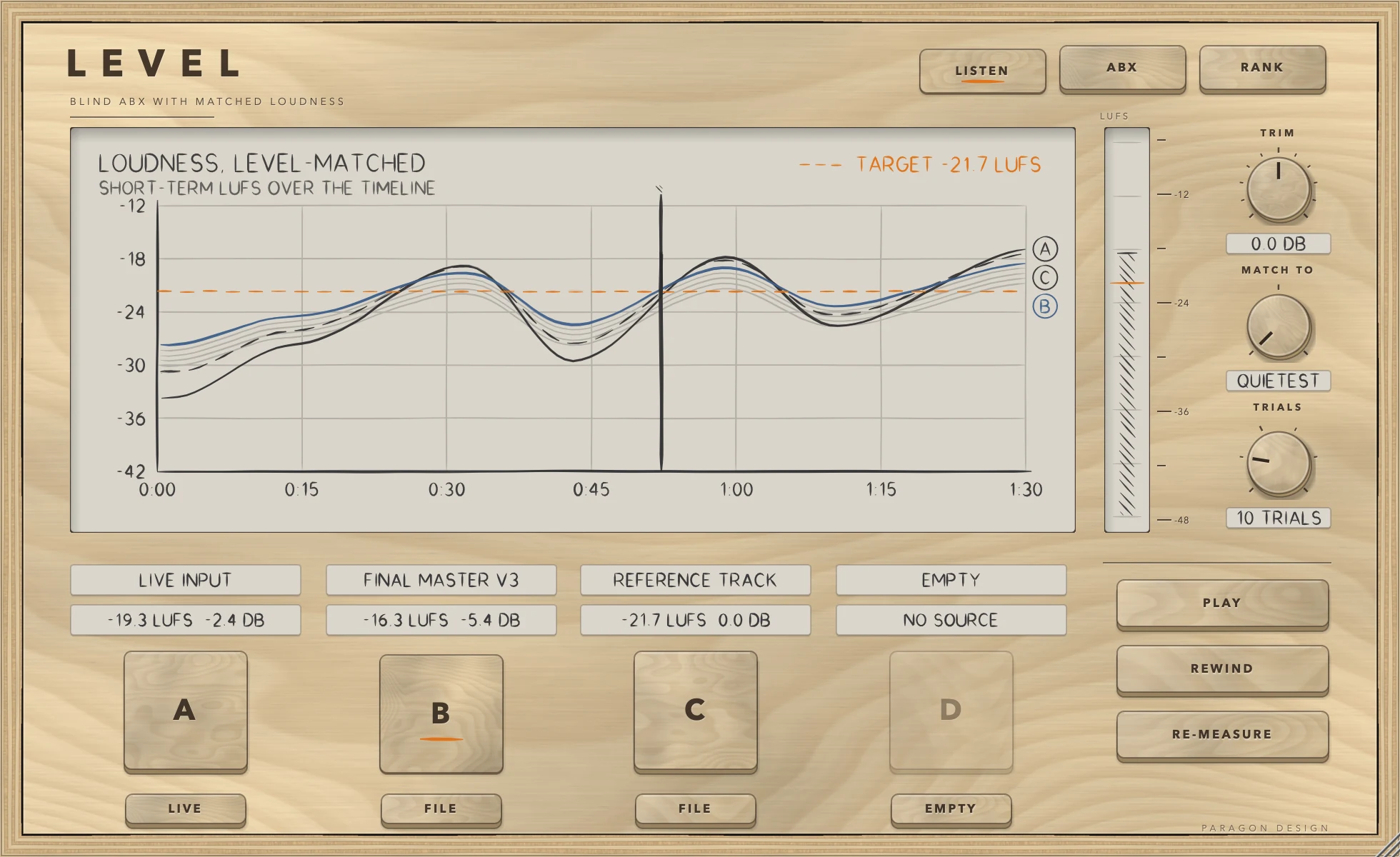
    Each slot is the live input or a file. LEVEL measures every source to BS.1770 and brings them to the same loudness: the quietest, slot A, or the EBU R128 level of -23 LUFS. The match does not move during a test.

  2. 02

    Blind ABX

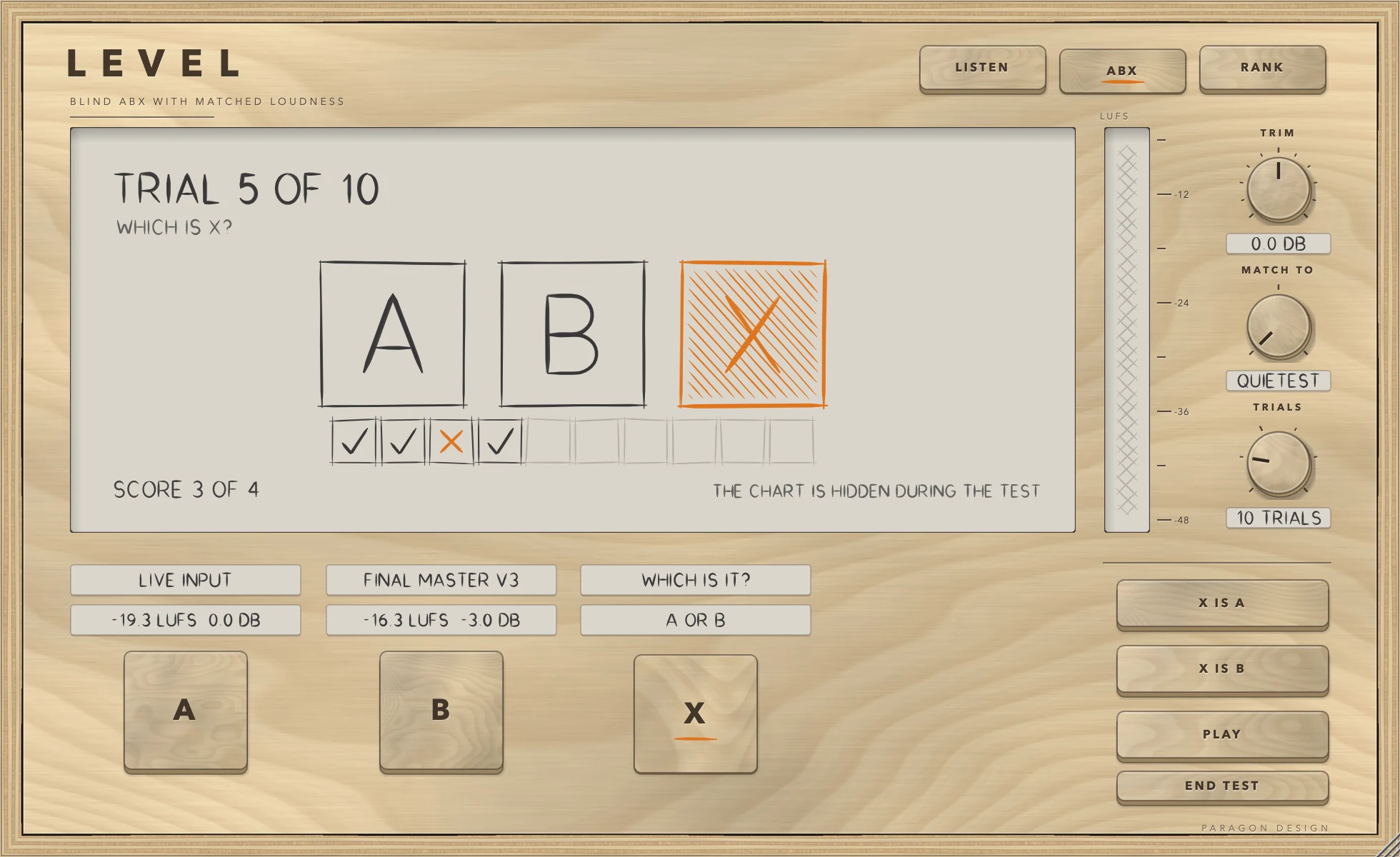
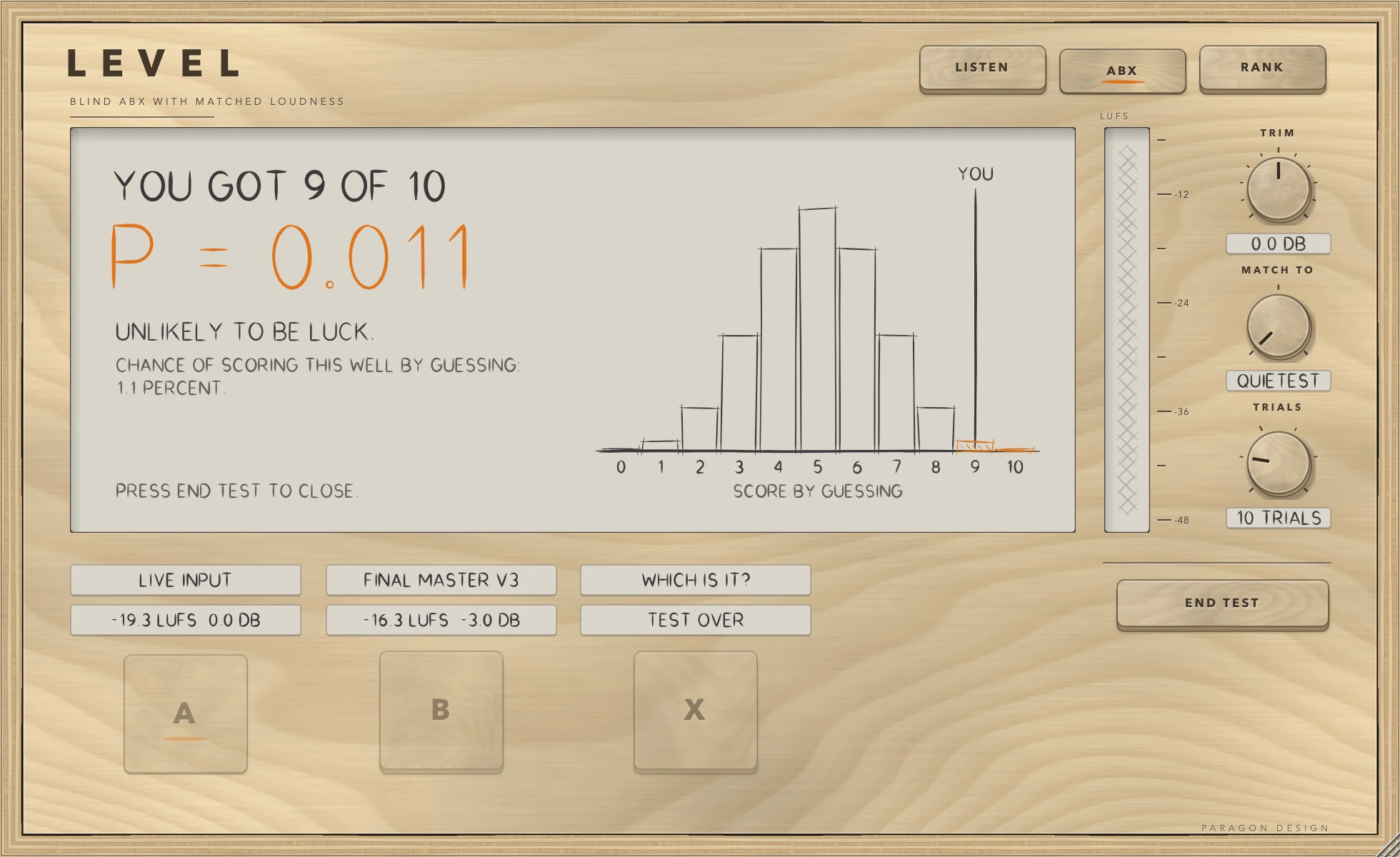
    X is secretly A or B. Listen as often as you like, then answer. Five to thirty trials, and an exact binomial p-value: 9 of 10 is 0.0107, and 12 of 12 is 1 in 4096. The panel prints three decimals, and P < 0.001 below that.

  3. 03

    Blind ranking

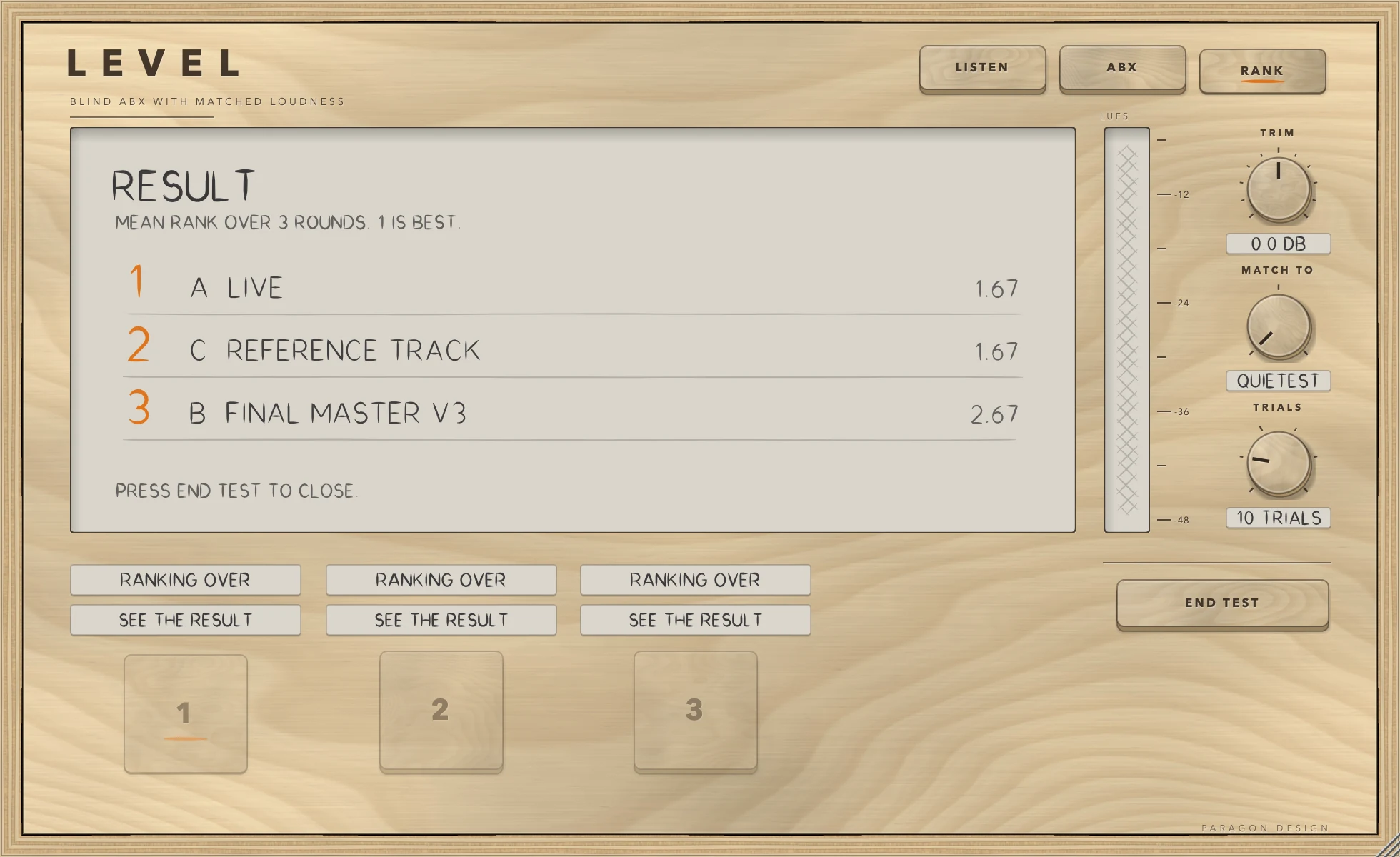
    Put the sources in order, best to worst, over three rounds, and see the mean rank of each at the end.

  4. 04

    The display keeps the secret

    While a test runs the chart and the loudness bar are hidden, and what X really is is never written into the saved project.

LEVEL · The point of it

A blind test where level cannot give the answer away.

A comparison between two mixes, two converters or two plug-in settings is only fair when the levels agree. A louder version is easy to prefer for that reason alone.

LEVEL measures each source with the BS.1770 loudness meter and sets a gain for each, then holds those gains still for the whole test. The answer to each trial is drawn at random and kept out of sight: the display, the meter and the saved state never show which of A or B is X.

  • 0.005 LULoudness against ffmpeg's EBU R128 meter: -19.568 LUFS here, -19.573 from ffmpeg, on the same file.
  • 0.002 LUTwo files 8 LU apart, after matching, come out within 0.002 LU of each other.
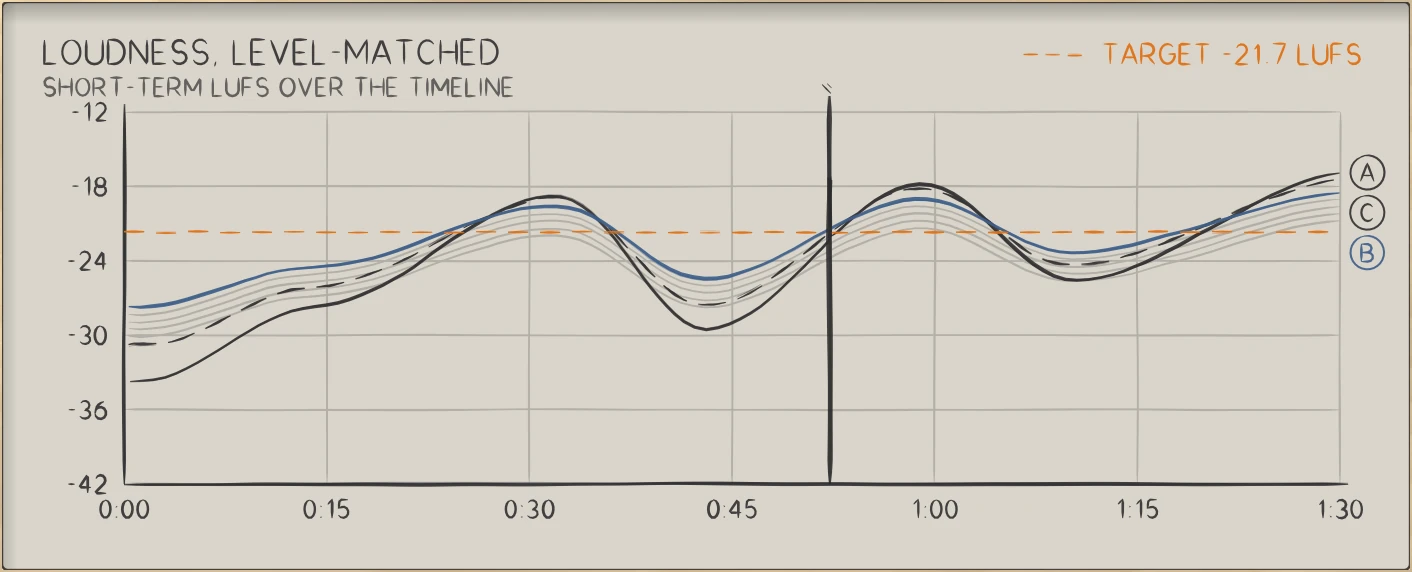
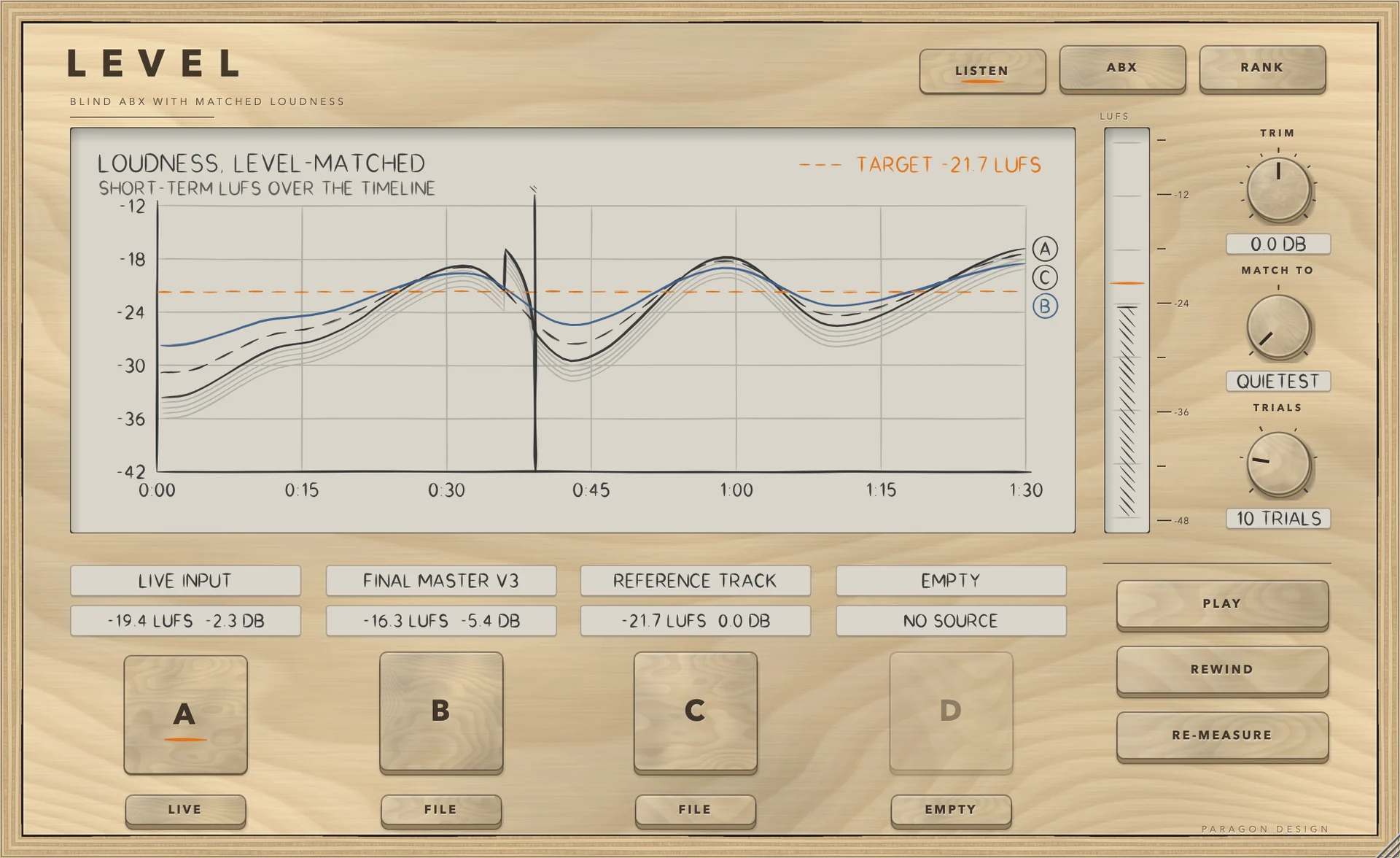
LEVEL: Loudness of four sources over the timeline, level-matched. In a test this chart is hidden.
Loudness of four sources over the timeline, level-matched. In a test this chart is hidden.

A small demonstration

Which one sounds better?

The same four-note chord, twice. One of the two is 1 dB louder, and nothing else differs. Turn your volume down first, play both, and pick the one you prefer. This is not LEVEL; it is the reason LEVEL exists.

Round 1 of 5

Play A and B to choose.

In use

The real window, as it looks at work.

These are captures of the built plug-in, drawn by the plug-in itself at twice the size.

LEVEL: Listening to the sources, matched in loudness
Listening to the sources, matched in loudness
LEVEL: A blind ABX in progress
A blind ABX in progress
LEVEL: The result of ten trials
The result of ten trials
LEVEL: A blind ranking, after three rounds
A blind ranking, after three rounds

Specifications

Formats
Audio Unit, VST3
Listed in your host as
Level Blind Listening Test
Channels
Mono or stereo, same in and out
Latency
None
Sources
Up to four: live input or file
Files read
WAV, AIFF, FLAC, MP3, AAC (M4A), CAF, Ogg Vorbis and others macOS can decode
Matching
To the quietest source, to slot A, or to EBU R128 (-23 LUFS)
ABX trials
5, 10, 15, 20, 25 or 30
Parameters
4 (output trim, match, trials, bypass)

Measured

  1. 0.005 LULoudness against ffmpeg's EBU R128 meter: -19.568 LUFS here, -19.573 from ffmpeg, on the same file.
  2. 0.002 LUTwo files 8 LU apart, after matching, come out within 0.002 LU of each other.
  3. Exactp-values are the exact binomial: 10 of 10 is 0.0010 and 12 of 16 is 0.0384 (the panel rounds to three decimals).

On synthetic test signals, by this plug-in’s own tests. Not a listening test.

The first minutes

From empty to useful.

  1. 1

    Fill the slots

    Put LEVEL on the track or bus, choose what plays in each slot, and let it measure.

  2. 2

    Listen, matched

    Switch between the sources. Each plays at the same loudness, so what you hear is the sound.

  3. 3

    Test yourself

    Start an ABX or a ranking. Answer by ear. The result and its p-value come at the end.